Feminine Arising
A daily practice app designed so the software gets out of the way.
Caso de estudio en inglés
Kaye had built a practice that works because it is unhurried and private. Almost every default in app design pulls the other way — streaks, nudges, encouragement, a chat box that wants another turn. The design problem was not what to add. It was deciding, precisely, what the software must never do, and then building something that still feels present while doing almost none of it.
The practice happens on paper. The app is not the place it lives.
Eleven days, fifteen quiet minutes each. A prompt arrives, and the actual work — the writing, the drawing — happens offline, in a notebook, away from the screen. That is the point of it. Writing by hand slows a person down and keeps them unobserved.
So the software had to be comfortable being the smaller part. Each day hands over a prompt and then steps back: “Take this prompt with you offline. A notebook, a loose sheet of paper, whatever is near. Return when you’re ready.” There is no canvas, no free-form journal box, no capture of the thing itself.
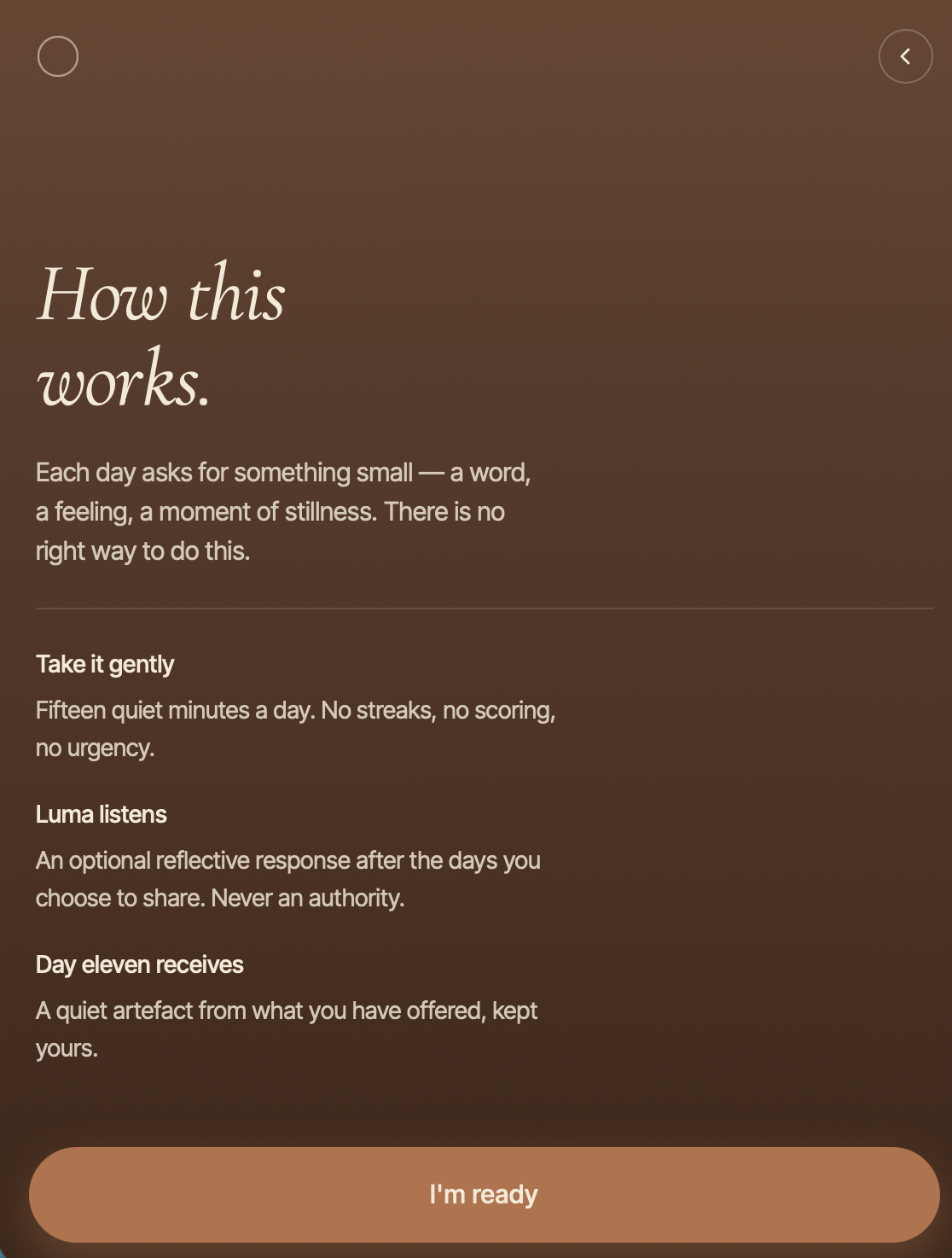
What comes back is deliberately thin — a few optional words, if they come. Building a daily-use product whose central interaction happens somewhere else turned out to be the whole design brief.
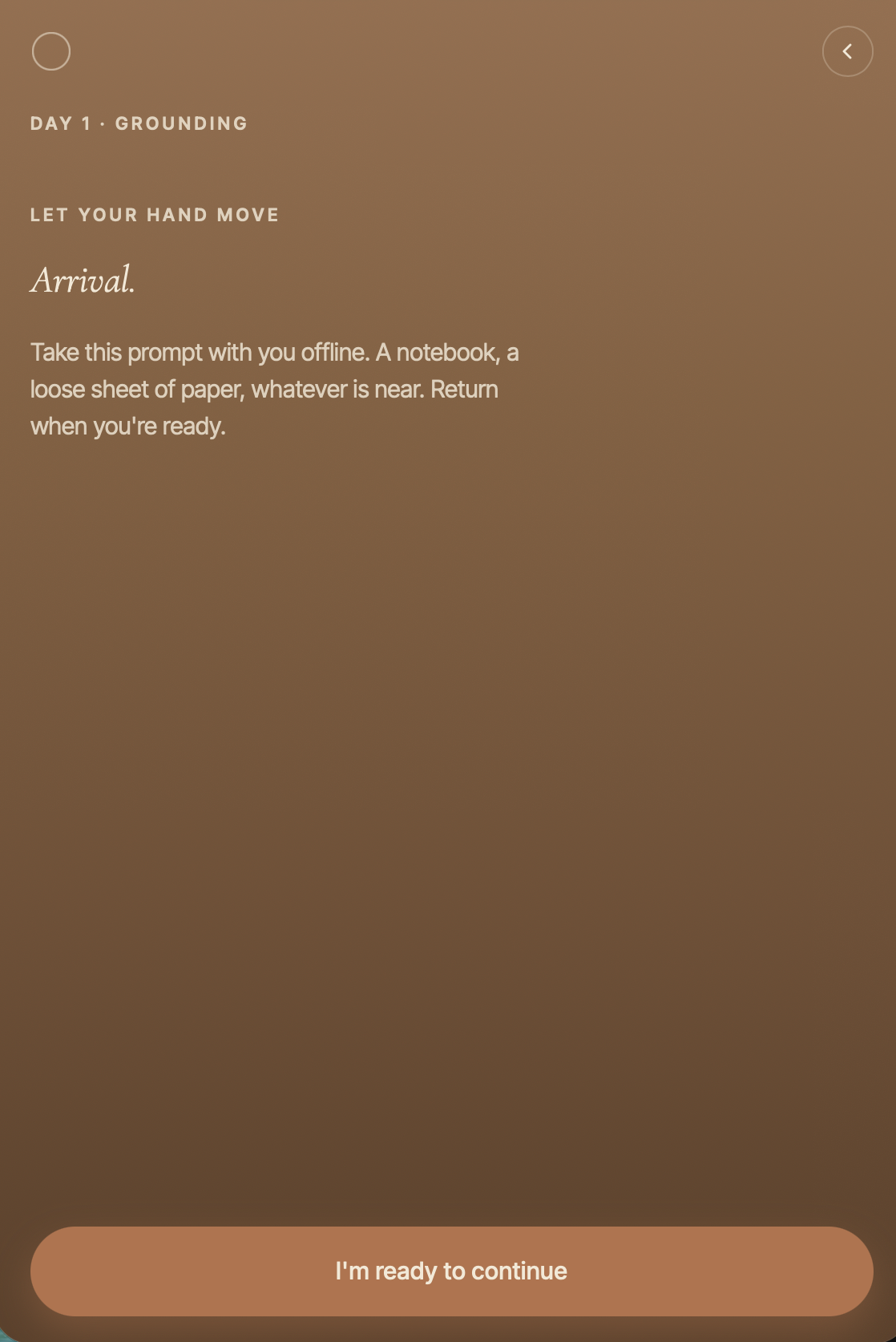
Every engagement pattern had to be argued out of the build.
A product used daily for eleven days is exactly where streaks, progress scoring, reminders and autoplay normally end up. Each one would have quietly changed what the practice is: something you can fall behind on, something that performs for you.
The constraints became explicit and testable rather than a matter of taste. Silence is the default state — audio exists, but it is opt-in and never plays on its own. Error states stay calm and human, with no system language and no codes, because an alarm in a reflective space is worse than a missing image. There is no metrics summary waiting when someone returns.
The product says this out loud on the way in, which is the part I am most glad about: fifteen quiet minutes a day, no streaks, no scoring, no urgency. A promise on the marketing page is a claim. The same promise as a build constraint is a product.
- No streaks, no scoringNothing accumulates, so nothing can be broken or lost.
- Silence by defaultAmbient audio is offered, never started for you.
- Nothing waiting on returnNo announcements, no catch-up prompts, no summary of what was missed.
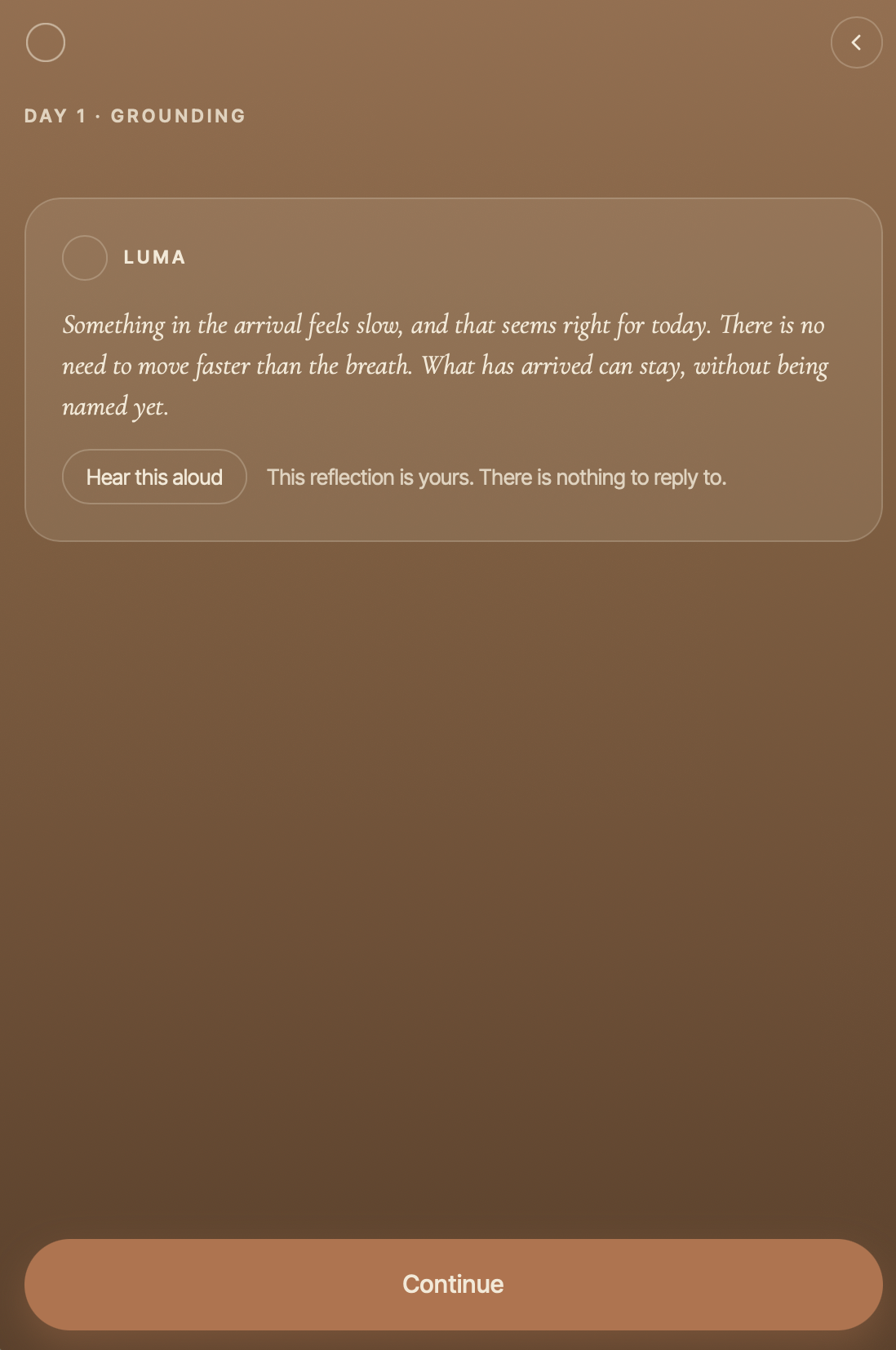
An AI that reflects once, then stops.
Luma is the reflective layer, built to Kaye’s behavioural specification. She appears only if a participant chooses to share, offers one short reflection, and then the exchange closes. The participant can let it rest, offer one more thing, or correct something that was misread — and that is the entire surface.
Almost every instinct an assistant has is disallowed here. No questions, no advice, no praise, no reassurance, no lessons. Luma describes a drawing and never interprets it. She works only from what the participant actually wrote, never from the day’s prompt, which she is not given. And she says plainly that she is an AI.
The interface had to carry that contract, not just the prompt behind it. The reflection arrives as a card that ends the conversation rather than inviting one: “This reflection is yours. There is nothing to reply to.” No input, no chat affordance, no blinking cursor. Getting a language model to be this quiet is mostly an exercise in removing the places where it would otherwise be asked to speak.
- Sharing is the triggerLuma never initiates a day, never sends the prompt, never speaks first.
- One reflection, then closedLet it rest, one more thing, or a correction. The practice itself does the closing.
- Honest about what it isDisclosed as an AI in onboarding and in the FAQ. No implied presence or feeling.
- A floor under itLanguage indicating risk routes to real, location-appropriate help rather than a reflection.
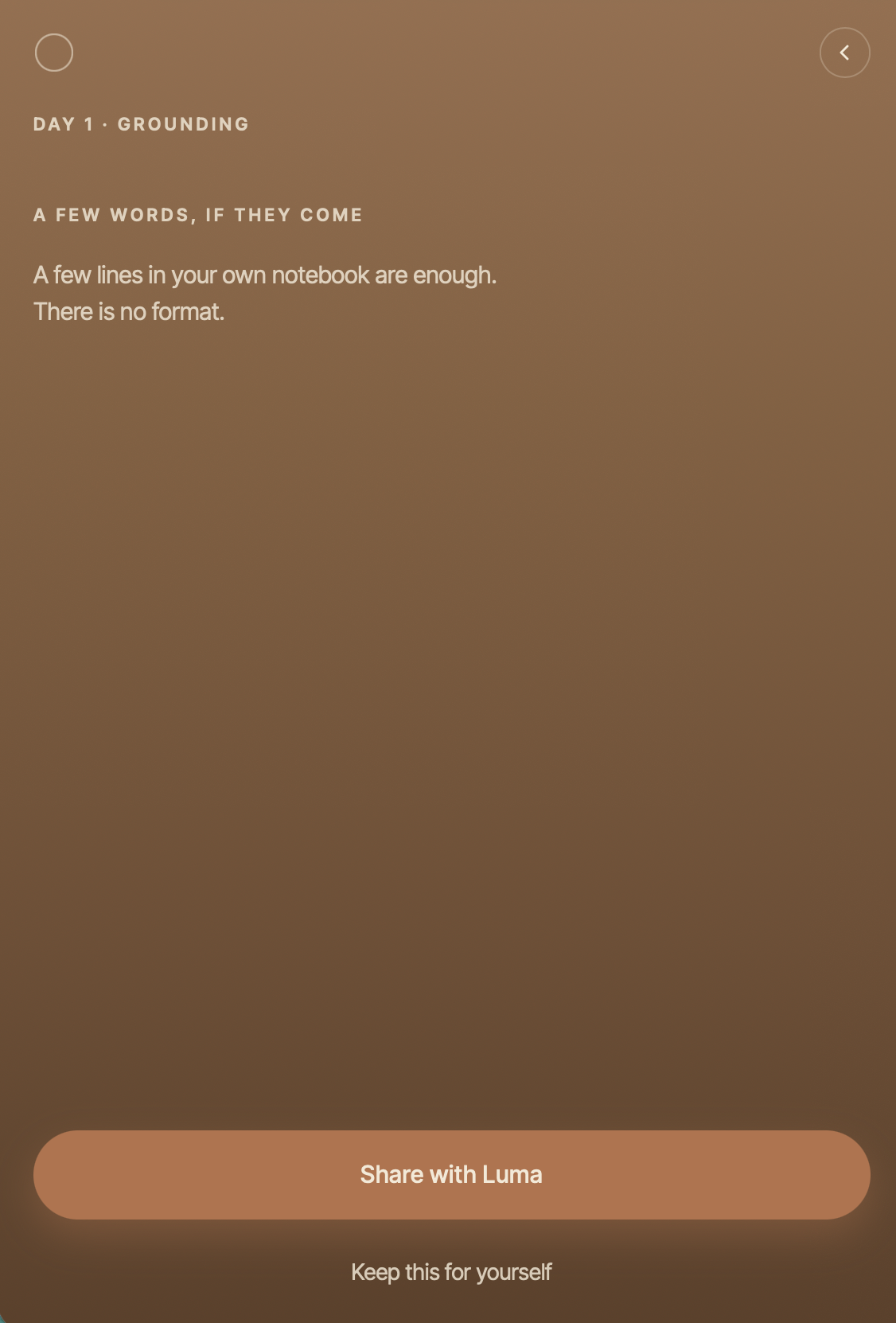
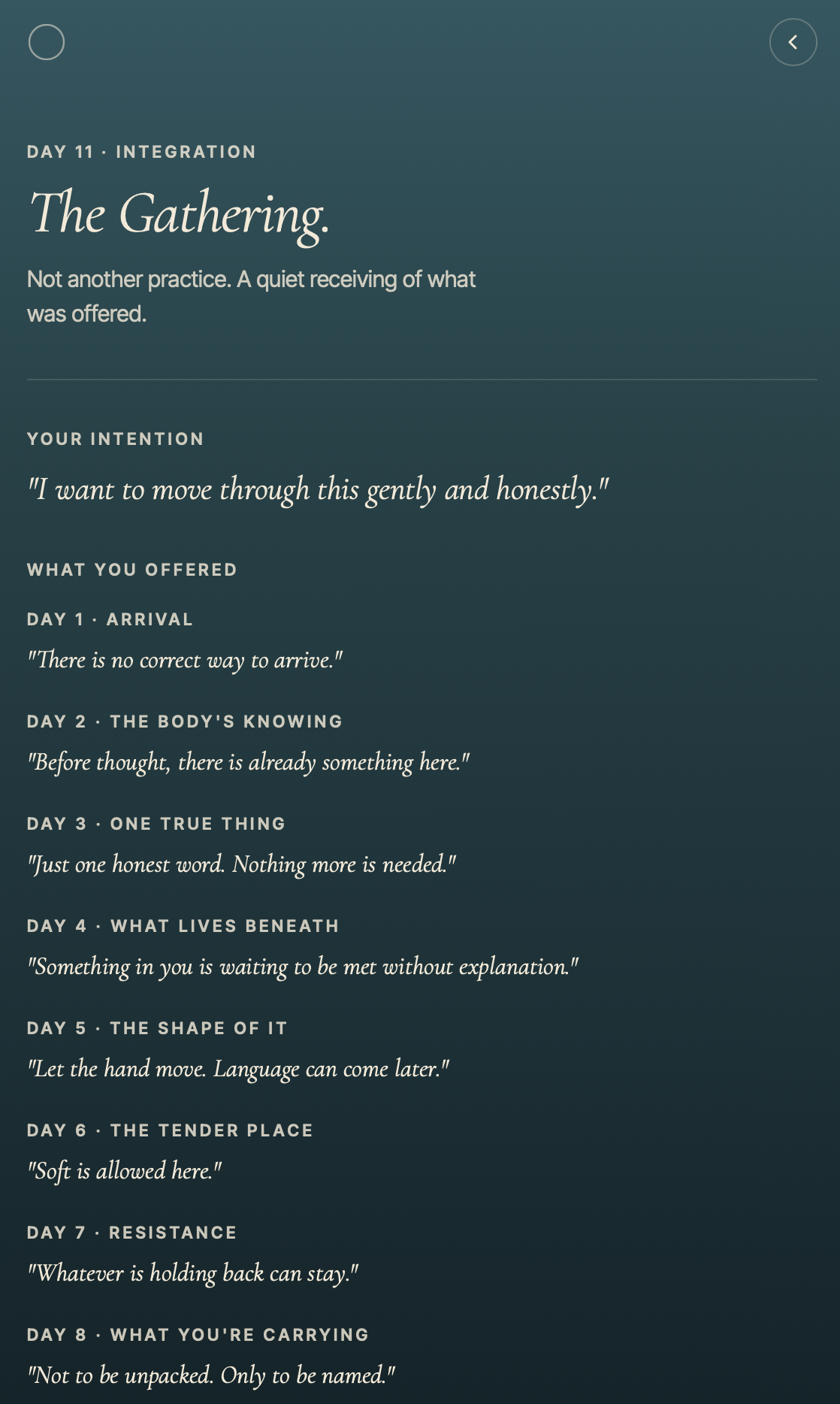
Eleven days that travel inward, including in colour.
The days are named rather than numbered in the copy — Arrival, The Body’s Knowing, One True Thing, The Shape of It, The Tender Place, Resistance, What You’re Carrying, The Return. The palette moves with them.
The rule we held was that the colour arc descends and never resets to surface light. Day eleven is not a sunrise or a celebration screen; it is the most interior point of the journey, and it shifts out of the warm earth tones into something cooler and quieter to say so.
Day eleven gathers what the participant offered across the ten days and gives it back — their own words, nothing invented, nothing scored. Where the next stage is not built yet, the product says that in its own voice rather than hiding it: “This is still being prepared.”
LiveSite and the eleven-day practice, shipped
11 daysGuided practice, named and sequenced
0Streaks, scores, nudges or autoplay
Shereen brings a rare combination of professionalism and deep understanding of a brief. She translates vision into structured, thoughtful work with clarity, heart, integrity and ease.
- The strongest design decisions on this project were subtractions. The product is defined as much by what I deliberately kept out as by what we built.
- Writing the behavioural rules as acceptance criteria rather than guidance was what made Luma’s restraint survive implementation. Tone guidance alone would not have held once a language model was in the loop.
- Keeping “keep this for yourself” visually equal to “share with Luma” mattered more than any amount of copy about privacy.
- The practice shipped first on purpose. It works on paper and in the browser without Luma, so the AI layer can arrive without becoming the thing the practice depends on.