Teachino
Lesson planning without the complicated software.
Case Study auf Englisch
Teachers don’t have time for complicated software. As Teachino’s first designer, I built a lesson planner that hides every complication — for a sceptical audience.
Teacher-planning constraints
Teachers already juggle curriculum, calendars and materials, and many still fall back on paper because software often adds another job instead of removing one. Teachino was building an AI-powered lesson planner for educators across Austria, Germany and South Tyrol.
I joined as the first designer with no existing design foundation. The challenge was making all that complexity feel simple enough that paper stopped being the easier option.
Design ownership
I owned the whole design surface: product UX and UI, research, the design system, parts of the brand and direct product work with the founder.
There was very little distance between a question and a decision. That made it possible to build the product and the way we designed the product at the same time.
- Product design, 0→1UX and UI for every MVP surface, onboarding to collaboration.
- Design systemTokens, components, the library the product was built from.
- BrandingProfessional, flexible, warm enough for teachers.
- Research and testingWorkshops, hallway tests, feedback looped back in.
- FacilitationRemote workshops for the team, sometimes well outside UX.
Research with 40+ educators
I worked with 40+ educators through workshops, tests and co-creation. The recurring signal was simple: teachers did not want a product packed with possibilities; they wanted one place that made the day easier to understand.
So one question became a useful filter for the work: does this add cognitive load, or remove it?
System + MVP in parallel
The design system did not get six quiet months before the product began. It grew alongside the MVP, and a component earned its place by solving a problem more than once.
We kept the loop short: define the essential scope, build real surfaces, put them in front of teachers and feed what we learned back into the next iteration. The system existed to keep shipping coherent as the product grew.
- Sprint zero to lock MVP scope.
- System and first surfaces built at once.
- Co-creation with teachers throughout.
- Founder as product partner — direct, weekly.
- Launch, then iterate on real teacher feedback.
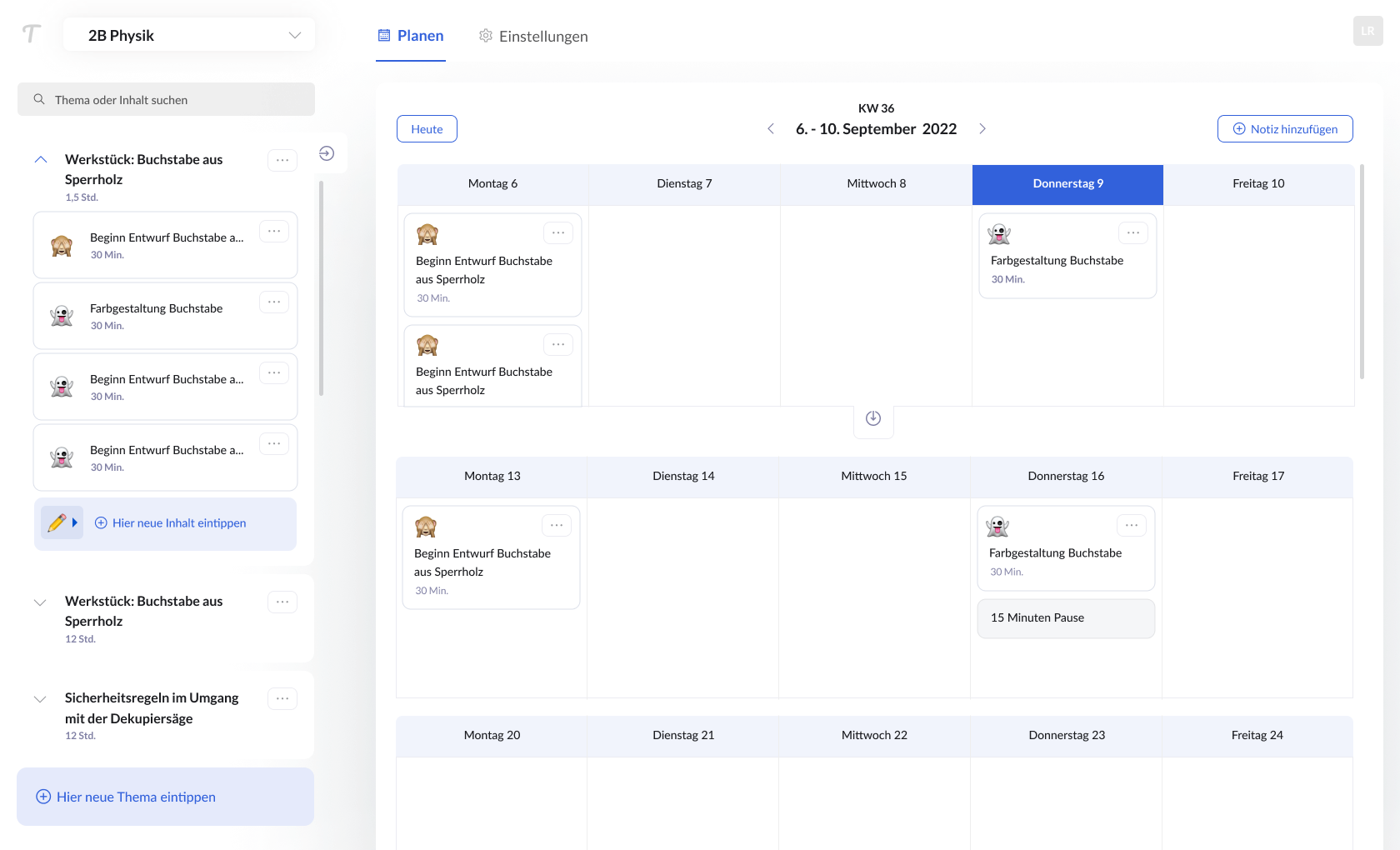
Six product surfaces
Calendar, content, today view, onboarding, student access and collaboration all had different jobs, but they needed one mental model. The design system gave those six surfaces a shared structure without making the product feel rigid.
The calendar is the clearest version of that idea: a teacher’s week, visible and understandable in one place.
Teacher feedback
Teacher feedback went straight back into the product. People could see suggestions become changes, making iteration part of the relationship with the team.
One teacher in South Tyrol put the result more plainly: “I only use Teachino for my prep now. I’ve almost completely let go of my paper planner.”
„Ich verwende für die Vorbereitung nur mehr Teachino, ich habe mich fast ganz von meinem Heft getrennt.“ — I only use Teachino for my prep now. I’ve almost completely let go of my paper planner.
Three-month launch
From kickoff to launched MVP took three months. The product went live across Austria, Germany and South Tyrol, with the design system and the product shipping together rather than one waiting for the other.
That is the result worth keeping: a working product taken from zero to launch quickly enough that real teachers could start shaping what came next.

3 monthsfrom kickoff to launched MVP
40+educators in the research loop
+20%task efficiency after redesigned flows
2×faster feature rollout with the design library
Shereen is wonderful to work with! With her great understanding of the education sector and fantastic UX skills we were able to ship our product super quickly. She built a robust design system as foundation for many features. We gathered a lot of customer feedback which Shereen was quick to include in next iterations. Any company would be lucky to have Shereen in their team.
- The design system and the product shipped at the same time. The constraint made both better.
- Founders make great product partners. Directness compressed the design cycle more than any process.
- Anyone can add features. The harder work is removing them and still feeling generous.
- Fast teams need research documentation inside the delivery rhythm, not as a separate phase.
- In education, trust is the design system before the design system.